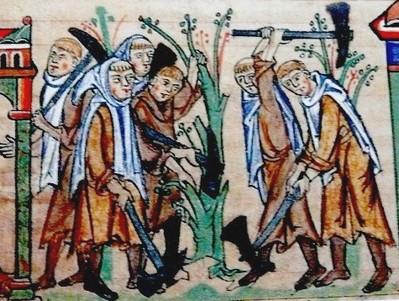
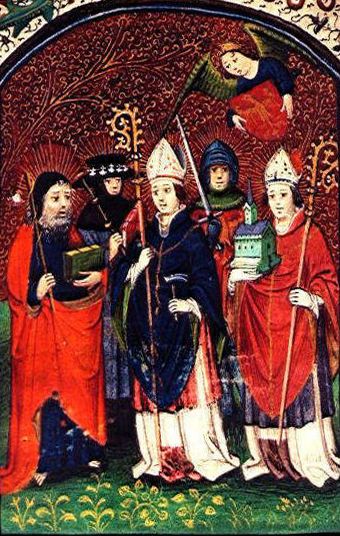
Behold: an evangelical theologian who wishes to medievalize evangelicalism–as I do!

A fascinating evangelical proposal to return to a medieval "sacramental ontology"

A week or so ago, I stumbled fortuitously on a book review in the pages of Books and Culture. Or to be more precise, on the glowing screen of B&C‘s website. This was a review by a Wheaton art historian of a book by the J. I. Packer Professor of Theology at Regent College, Vancouver, BC. This is an exciting book for me, as it handles with great historical and theological sophistication the themes of earthiness and embodiment, Creation and Incarnation, that have floated to the surface of my own attempt to write about a “usable medieval past.”

The book is Hans Boersma’s Heavenly Participation: The Weaving of a Sacramental Tapestry (2011). I find it rich enough that I would like to blog on it here in the coming weeks. What did Wheaton art prof Matthew Milliner say about it? Here’s a sample: Continue reading

Charles Sheldon as example of how pastors could better understand the working life of their congregants

Kansas 150/150

Charles Sheldon's blockbuster novel. READ IT!

A book that is sorely needed in today’s Christian world is John Knapp’s How the Church Fails Businesspeople (Knapp is a professor and head of an ethics center at Samford University in Birmingham, Alabama). He’s blogging on the concept, briefly, on his publisher’s website, and lo and behold, up pops one of my favorite classical, Christocentric liberals of the 19th century, Charles M. Sheldon. Yup. I dedicated a chapter to Mr. “What Would Jesus Do?” in my book Patron Saints for Postmoderns (yes, there’s a Kindle version, in case you get one of those hugely popular commerce devices this Christmas). Here’s Dr. Knapp’s take on Sheldon. Amen, John. May your book gain a wide audience:

Pastors who wish to better understand the weekday lives of their parishioners could learn a thing or two from the real-life example of a nineteenth-century minister named Charles Sheldon, best known for his classic novel titled In His Steps: What Would Jesus Do? Continue reading

Mark Galli on the recent troubles in AMIA (Anglican Mission in the Americas)

CT managing editor and AMIA minister Mark Galli on his denomination’s current troubles:

Some facts in the current crisis remain in dispute, and it will take months or years to sort them out. We need to understand what, in fact, was the relationship between Chuck Murphy and the Rwanda Province over the last few years. Continue reading

Neat series on John Milton’s Christian poem, Paradise Lost

English: Picturefirst published in the 1861's ...

Image from 1861 British edition of Paradise Lost

Found on Alan Jacobs’ excellent blog filled with snippets from the cyberworld, this neat series in the Guardian on John Milton’s Paradise Lost. A snippet (the one Alan presents, too):

By the time Milton reaches Book VII he has come to a kind of accord with his own frustration. All right, he says: I can’t get up to heaven, and if I try I “fall/Erroneous”. Writing purely about God, he comments, is like being an amateur rider on a particularly frisky winged horse. Humanity is the proper perspective for poetic endeavour; so he asks the Christian muse, Urania, to carry him downwards and deposit him safe in his “Native Element”. He will write now about the earth: about its nature, its making; about its creatures; about relationships and sex and intellectual curiosity and mistakes and sorrow and “the human face divine”.

This is most deeply God’s place to speak through his poet, he points out; singing amid violence; taking love into hell; readying himself for sacrifice, to be destroyed by the blind desires of an angry mob. The figure with whom he identifies in connection with this role is Orpheus, the prototype poet of myth. But, of course, he is thinking about Christ too, who in Christian theology is God suffering all that humans inflict on each other. There won’t be much explicit scope for Christ in Paradise Lost. But Milton sees his own position – surrounded by rabid Royalists, “fall’n on evil dayes”, slandered by “evil tongues” – as Christlike. In the face of violence, Milton too will sing.

Alvin Plantinga, apologist and pro-science thinker

English: Image of Alvin Plantinga released by ...

Alvin Plantinga

Reading the New York Times article that appeared today on recently retired Calvin College philosopher Alvin Plantinga almost (only almost) makes me want to join the apologetic fray. I’m just not cut out for it. But I’m glad that there are people like Dr. Plantinga around to point out that science and Christian faith, far from being incompatible, are in fact twins in the womb (or to be more precise, Western science would not have happened without Christianity):

On the telephone Mr. Plantinga was milder in tone but no less direct. “It seems to me that many naturalists, people who are super-atheists, try to co-opt science and say it supports naturalism,” he said. “I think it’s a complete mistake and ought to be pointed out.” Continue reading

“Chaplaincy” role(s) for pastors? For congregations?

*AS OF 6:15 CST TODAY (DEC 5), THE INTERNET MONK SITE, WHICH WAS DOWN FOR THE AFTERNOON, IS UP AGAIN. CHECK IT OUT: THE LINK BELOW IS WELL WORTH ACCESSING.

Friend John Armstrong posted an interesting discussion I’d like to pass on to readers:

Last week my friend Mark Galli wrote a post on the need for more pastors who loved and shepherded their congregations as chaplains. I attend a funeral on Saturday and saw this happen in the most amazing way I’ve ever witnessed. I wish I had a DVD of what I saw. Every pastor in America should learn how to be a chaplain in a funeral service. Then my friend Tod Bolsinger wrote a great response suggesting that what we needed is a missional leader(s), not chaplains. I agree, to a point, but I also found myself thinking this is not a both/and but an either/or. Then this morning Michael Mercer, the Internet Monk, responded and expressed my thoughts perfectly. Three friends all engaging one other in respect and humility. This is truly one of the finest dialogs among Christian leaders I’ve read in a long, long time.

www.internetmonk.com

Tod Bolsinger disagrees with Mark Galli. In a post on his blog, Bolsinger writes, We Need Chaplains…Just not More Of Them…Not Now. . . .

On pulling evangelicals back from the brink of Catholicism – Mark Galli’s wise words

Holy Spirit

Image by Barking Tigs via Flickr

Mark Galli, I love you as a brother in Christ. As managing editor in the flagship evangelical Protestant publication, Christianity Today, you have presented an impassioned and powerful case for why evangelical Protestants tempted to cross the Tiber and join with the Roman Catholic Church should think twice . . . and then remain in the evangelical fold. While I balk at some of your historical characterizations, I affirm your central point.

A word on those historical characterizations. Mark assert confidently: “Huge segments of the church were bound to the chains of works righteousness before the Holy Spirit ignited the Reformation.”

Really? “Huge segments”? While at Duke University (fountain of all wisdom, funded by tobacco money . . . and surprisingly loyal, in at least many parts of the Divinity School, to the Great Tradition), I learned different from David Steinmetz, the (Protestant) historian of the Reformation at Duke . . . unless, David, I interpreted your lectures wrongly:

Continue reading

An uncomfortable, but I think acute, take on “spiritual disciplines,” from Trinity’s D. A. Carson

Themelios

Image via Wikipedia

Friends, I’m not sure what to make of D. A. Carson‘s recent piece on spiritual disciplines in the pages of Themelios. Let’s say I’m processing. I see in his reflections both unfortunate Protestant bias (I think he misses entirely the intense Christocentrism of medieval mystics such as Julian of Norwich, which his colleague Carl Trueman in an earlier piece in the same organ did NOT miss), and acute gospel wisdom (“disciplines” must not mean gritting our teeth and doing things under our own steam–a point he makes later in the piece). I’d be interested in comments from y’all. Below is a sample. The whole article may be found here.

How shall we evaluate this popular approach to the spiritual disciplines? How should we think of spiritual disciplines and their connection with spirituality as defined by Scripture? Some introductory reflections:

(1) The pursuit of unmediated, mystical knowledge of God is unsanctioned by Scripture, and is dangerous in more than one way. It does not matter whether this pursuit is undertaken within the confines of, say, Buddhism (though informed Buddhists are unlikely to speak of “unmediated mystical knowledge of God“—the last two words are likely to be dropped) or, in the Catholic tradition, by Julian of Norwich. Neither instance recognizes that our access to the knowledge of the living God is mediated exclusively through Christ, whose death and resurrection reconcile us to the living God. To pursue unmediated, mystical knowledge of God is to announce that the person of Christ and his sacrificial work on our behalf are not necessary for the knowledge of God. Sadly, it is easy to delight in mystical experiences, enjoyable and challenging in themselves, without knowing anything of the regenerating power of God, grounded in Christ’s cross work.

(2) We ought to ask what warrants including any particular item on a list of spiritual disciplines. For Christians with any sense of the regulative function of Scripture, nothing, surely, can be deemed a spiritual discipline if it is not so much as mentioned in the NT. That rather eliminates not only self-flagellation but creation care. Doubtless the latter, at least, is a good thing to do: it is part of our responsibility as stewards of God’s creation. But it is difficult to think of scriptural warrant to view such activity as a spiritual discipline—that is, as a discipline that increases our spirituality. The Bible says quite a lot about prayer and hiding God’s Word in our hearts, but precious little about creation care and chanting mantras.

Baylor scholar Roger Olson on Pietism

Hat tip to my friend, IV staffer Charlie Clauss, for providing a link to video of two talks given by Dr. Roger Olson on Pietism. Thanks Charlie. You can click on the title, below, to access the videos:

AUS MEMORIAL LECTURE – MARCH 15, 2011

PIETISM: A WORLD WE HAVE LOST AND NEED TO FIND AGAIN

Roger Olson
Professor of Theology, George W. Truett Theological Seminary of Baylor University, Waco, Texas

Good grief: On attending to the body and not just the soul in death

[Viewing Casket, Museum of Funeral Customs, Springfield, Illinois, 2006]

Many thanks to Rob Moll for pointing me to the following wonderful article on death and funerals by Thomas Lynch. The article is years old now, but Lynch, who is a funeral director, has a message that we still need to hear. And because I know from looking at the statistics on this site that many readers don’t click through the links to articles that I provide, contenting themselves to read just the excerpt in the blog page, I want to excerpt here the part of the article that I found most powerful–its ending. 

But let me say: the whole thing is well worth reading (despite the frequent typos owing to poor scanning and editing). In the first half of the article, Lynch challenges eloquently and effectively the super-spiritualizing presumption that my body, your body, in death even as in life, is “just a shell.” The argument is particularly poignant for me, as I have just in recent weeks attended my grandmother’s memorial service–that convenient gathering at which the body (“shell”) is notably absent, except in this case by the representative urn of ashes. Here is the conclusion to which that argument leads:

Among the several blessings of my work as a funeral director is that I have seen the power of such faith in the face of death. I remember the churchman at the deathbed of a neighbor — it was four in the morning in the middle of winter — who gathered the family around to pray, then helped me guide the stretcher through the snow out to where our hearse was parked. Three days later, after the services at church, he rode with me in the hearse to the grave, committed the body with a handful of earth and then stood with the family and friends as the grave was filled, reading from the psalms — the calm in his voice and the assurance of the words making the sad and honorable duties bearable.

I remember the priest I called to bury one of our town’s indigents — a man without family or friends or finances. He, the gravediggers and I carried the casket to the grave. The priest incensed the body blessed it with holy water and read from the liturgy for 20 minutes, then sang In Paradisum – that gorgeous Latin for “May the angels lead you into Paradise” — as we lowered the poor mans body into the ground. When I asked him why he’d gone to such trouble he said these are the most important funerals — even if only God is watching — because it affirms the agreement between “all God’s children” that we will witness and remember and take care of each other. Continue reading